
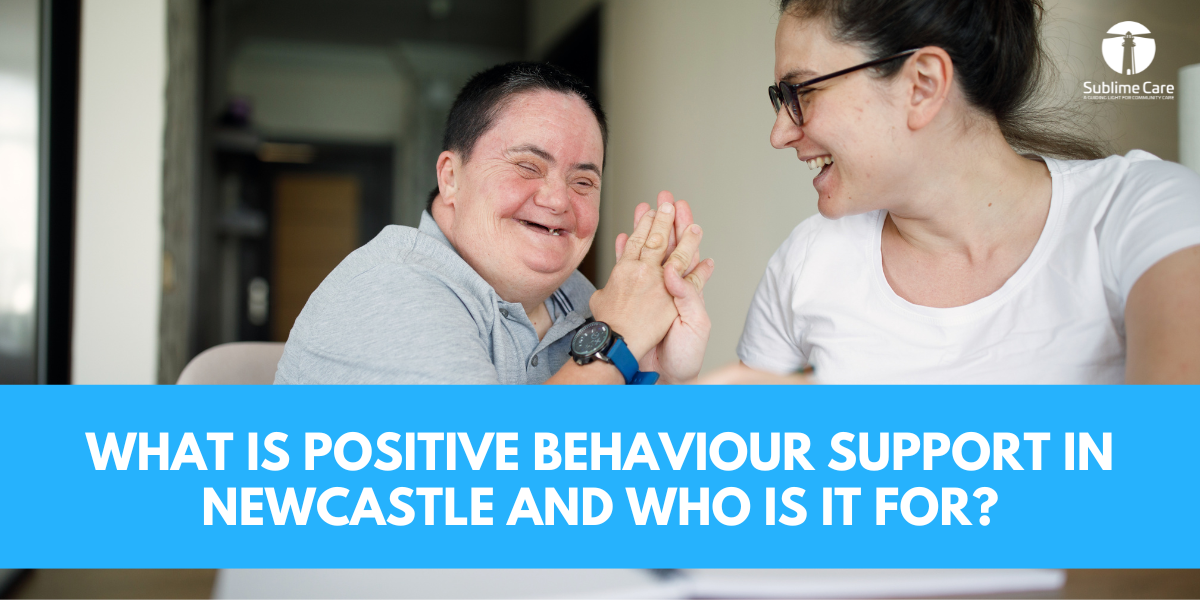
If you support a family member with disability or are an NDIS participant yourself, you may have come across the term Positive Behaviour Support (PBS). It is a person-centred approach that helps participants develop strategies to improve their quality of life and support positive changes in behaviour. People often misunderstand this NDIS support because they may confuse it with punishment-based approaches or feel unsure when it applies to them. This article explains what Positive Behaviour Support is and who it can support. It also covers how it works and how to access it through a registered NDIS provider such as Sublime Care in Newcastle and the Hunter Region.
What Is Positive Behaviour Support?
According to the NDIS Quality and Safeguards Commission, Positive Behaviour Support is an evidence, values, and rights-based approach to supporting people with disability who display behaviours of concern (NDIS Quality and Safeguards Commission). Rather than simply managing or suppressing a behaviour, PBS looks at the reasons behind it. A behaviour of concern is usually a form of communication. It might signal pain, frustration, unmet sensory needs, anxiety, or difficulty expressing a want or need. PBS works to understand the underlying cause and develop genuine, lasting solutions around it.
This is an important distinction from restrictive practices, such as physical, chemical, mechanical, or environmental restraint, or seclusion. The NDIS Commission is clear that restrictive practices do not create lasting positive change and can, in some cases, make behaviours worse over time. Where a restrictive practice is still necessary for someone’s safety, it must be part of a broader Positive Behaviour Support framework with clear safeguards. There must also be an explicit, documented plan to reduce and eventually eliminate its use.
Who Is Positive Behaviour Support For?
Positive Behaviour Support is for NDIS participants of any age who experience behaviours of concern. These behaviours may affect their quality of life, relationships, or ability to take part in everyday activities. This can include behaviours linked to autism, intellectual disability, acquired brain injury, or psychosocial disability.
A common misconception is that a behaviour needs to reach crisis point before PBS is worth considering. Earlier engagement can lead to better outcomes by addressing concerns before they become more established. It also allows strategies to be put in place before safety risks develop. Families, carers, support coordinators, or participants themselves can request a referral for PBS at any stage.
Who Delivers Positive Behaviour Support?
PBS is delivered by behaviour support practitioners who have been assessed as suitable by the NDIS Commission against the Positive Behaviour Support Capability Framework (NDIS Quality and Safeguards Commission). The Framework sets out four capability levels: core, proficient, advanced, and specialist. Practitioners should work within the limits of their demonstrated skills and experience. The NDIS Commission classifies behaviour support as a high-risk support. Providers must register and meet specific practice standards to deliver it.
How Does a Positive Behaviour Support Service Work?
While the exact process varies by provider, a typical PBS service generally includes the following stages:
Functional assessment. A behaviour support practitioner works with the participant, their family, and broader support team to understand what is driving the behaviour of concern. The focus is on understanding the underlying cause rather than simply observing the behaviour itself.
Individualised behaviour support plan. The practitioner develops a written plan with strategies tailored to the person’s goals, environment, and communication style. This may include an interim plan for urgent situations, followed by a comprehensive plan.
Implementation and training. Family members, support workers, and others in the participant’s life are trained to apply the strategies consistently. Consistent responses are important because inconsistency can undermine progress.
Review and adjustment. Behaviour support plans are not static documents. They are monitored and refined as circumstances change or as new information comes to light.
Reduction of restrictive practices. Where restrictive practices are already in use, the plan documents a clear pathway to reduce and, where possible, eliminate them.
How Is Positive Behaviour Support Funded?
Positive Behaviour Support is generally funded under the Capacity Building Supports budget in an NDIS plan, most often within the Improved Relationships category (NDIS). Funding levels depend on individual assessed needs. If you think PBS could help, it is worth discussing this with your Support Coordinator, Local Area Coordinator, or NDIS planner.
Positive Behaviour Support in Newcastle and the Hunter Region
Sublime Care provides Positive Behaviour Support to NDIS participants across Newcastle and the Hunter Region, with behaviour support practitioners working within the NDIS Positive Behaviour Support Capability Framework. Support is available for participants of all ages, and the team notes that a behaviour does not need to be severe before it is worth reaching out (Sublime Care – Positive Behaviour Support).
If your family is in Newcastle or the surrounding Hunter Region, you may be unsure whether Positive Behaviour Support is the right fit. The first step is usually a conversation to discuss your needs rather than a formal referral. Sublime Care’s team can talk through what you are noticing at home, what has already been tried, and whether a functional assessment would help. You can find more about Sublime Care’s broader allied health offering, including Speech Pathology, Occupational Therapy, and Physiotherapy, on the Allied Health Services page.
Frequently Asked Questions
Is Positive Behaviour Support only for children? No. PBS supports NDIS participants of any age, including adults, where a behaviour of concern is affecting their wellbeing or participation in daily life.
Does a diagnosis of autism automatically mean I need PBS? No. PBS is based on the presence and impact of a behaviour of concern, not a specific diagnosis. Many autistic NDIS participants do not require PBS, while some people without an autism diagnosis do.
Is Positive Behaviour Support the same as a behaviour management plan from a school or workplace? Not necessarily. A school or workplace plan may address behaviour in a specific setting, while an NDIS behaviour support plan is developed by a registered behaviour support practitioner and can apply across a person’s whole support network.
How do I start the process? You, a family member, or a support coordinator can make a referral to a registered NDIS behaviour support provider. In Newcastle and the Hunter Region, you can contact Sublime Care to discuss a referral or ask questions before committing to a service.
Getting Support
Positive Behaviour Support is designed to improve quality of life, not to control or punish. If you support someone experiencing behaviours of concern, or experience them yourself, an early conversation with a registered behaviour support practitioner can help. They can identify practical, respectful strategies before the situation escalates. To find out more or arrange a referral in Newcastle or the Hunter Region, visit Sublime Care’s Positive Behaviour Support page or contact the team directly.