
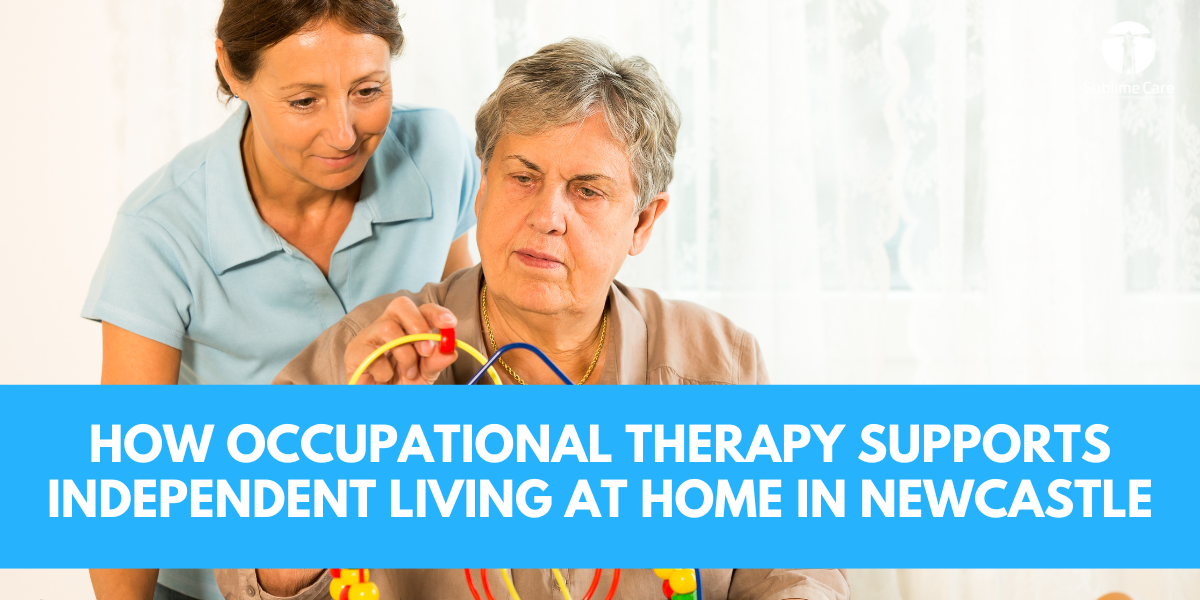
Staying independent at home remains a common goal for older Australians and NDIS participants, whether showering, cooking, or moving safely. Occupational therapy is one of the key allied health services that helps people build skills and confidence for independent living. This article explains occupational therapy, how it supports independence at home, and how Newcastle and Hunter residents can access services.
What Is Occupational Therapy?
According to Healthdirect Australia, “occupational therapy can help you take part in the activities that you find meaningful,” whether that relates to self-care, work, study, leisure, or social participation (Healthdirect Australia – Occupational Therapy). An occupational therapist considers a person’s goals, physical and cognitive abilities, and environment when assessing their needs. They then develop practical ways to bridge the gap between what someone wants and what their current situation allows. This can involve building new skills or adapting how someone completes a task. It can also involve changing the home environment to better suit the person’s needs.
How Occupational Therapy Supports Independent Living at Home
Functional assessment. An occupational therapist starts with a thorough assessment of how a person manages everyday tasks at home. This includes personal care, meal preparation, and moving safely around the house. This assessment identifies specific barriers to independence rather than relying on assumptions.
Home modifications. Where the physical environment is the barrier, an OT can recommend and help coordinate home modifications, such as ramps, grab rails, bathroom modifications, or wider doorways, to make a home safer and more accessible.
Assistive technology. OTs help identify and choose mobility aids and adaptive equipment that suit a person’s needs. These may include shower chairs and assistive technology that help people complete tasks safely with less strain on themselves or their carers.
Skill-building and task adaptation. Rather than only changing the environment, OTs often teach people new techniques for completing familiar tasks. This approach can help people recovering from illness or injury, as well as those managing chronic or progressive conditions.
Cognitive and mental health support. Occupational therapy is not limited to physical function. OTs also support people who experience cognitive changes or mental health conditions. They help people plan, organise, and manage their daily activities more effectively.
Energy and fatigue management. For people living with chronic conditions, an OT can help develop strategies to manage fatigue throughout the day. These strategies help people use their energy for the activities that matter most.
Who Can Access Occupational Therapy?
Occupational therapy is available to a broad range of people, not just those recovering from a specific injury. Under the NDIS, occupational therapy is a common allied health support for participants working toward daily living and independence goals. Under aged care, it is available through Support at Home and the Commonwealth Home Support Programme (CHSP) for older Australians who want to remain safely at home as their needs change. Because Sublime Care operates across both systems, participants do not need to know which funding pathway applies. The team can help clarify the options during an initial conversation.
Home Modifications and Assistive Technology in More Detail
For older Australians accessing Support at Home, the Assistive Technology and Home Modifications (AT-HM) scheme generally coordinates home modifications and assistive technology. Following an assessment by a qualified allied health professional, the scheme can fund items such as walkers, grab rails, ramps, and stair lifts. You can read more about how this works on Sublime Care’s Assistive Technology and Home Modifications page. For NDIS participants, home modifications and assistive technology are typically funded through the Capital Support budget in an NDIS plan, following an OT assessment that documents the need.
What Happens During an OT Home Visit?
While the exact process varies by provider and funding pathway, most occupational therapy support follows a similar pattern. First, a referral is made, either by the participant, a family member, a support coordinator, or through an aged care assessment outcome. An occupational therapist then conducts an assessment, often at the person’s own home, to see firsthand how they move through their space and complete daily tasks. Based on this, the OT develops recommendations, which might include specific equipment, home modifications, or a plan to build particular skills. The team then implements the recommendations by ordering equipment, coordinating trades for modifications, or supporting skills programs. They review the outcomes over time to ensure the solutions continue to meet the person’s needs.
Occupational Therapy in Newcastle and the Hunter Region
Sublime Care provides occupational therapy across Newcastle and the Hunter Region, supporting both NDIS participants and older Australians accessing aged care services. The team’s occupational therapy service covers functional assessments, home modifications, assistive technology, and tailored strategies to help participants remain as independent as possible in their own homes. You can find more detail on the Occupational Therapy page, or view the full range of allied health supports on the Allied Health Services page.
If you live in Newcastle or the Hunter Region, you may wonder whether occupational therapy could help. A conversation with an occupational therapist can help you understand your options before ruling it out. A referral does not commit you to a specific outcome, it simply starts an assessment process to understand what support, if any, would make the most difference.
Frequently Asked Questions
Is occupational therapy only for people with a physical disability? No. Occupational therapy also supports people managing cognitive changes, mental health conditions, chronic illness, and age-related decline, wherever it is affecting daily activities.
Do I need a referral to see an occupational therapist? Under the NDIS, occupational therapy is generally accessed through your plan, and a referral from a GP is not always required. Under aged care, occupational therapy is typically accessed following a My Aged Care assessment and support plan.
Can occupational therapy help prevent falls at home? Yes. A home assessment can identify fall risks, such as loose rugs, poor lighting, or a lack of grab rails, and an OT can recommend practical changes to reduce that risk.
How is occupational therapy funded? Funding depends on your circumstances. NDIS participants generally use Capacity Building or Capital Support funding, while aged care recipients access occupational therapy through Support at Home or CHSP funding following an assessment.
How do I get started with occupational therapy in Newcastle? You can contact a registered provider directly, such as Sublime Care, to discuss a referral, or ask your Support Coordinator or My Aged Care assessor to include occupational therapy in your plan.
Next Steps
Occupational therapy can make a genuine difference to how safely and independently someone lives at home, whether that is through a home modification, a new piece of equipment, or a new way of approaching a daily task. If you are in Newcastle or the Hunter Region and want to discuss occupational therapy support, contact Sublime Care to talk through your situation and referral options.